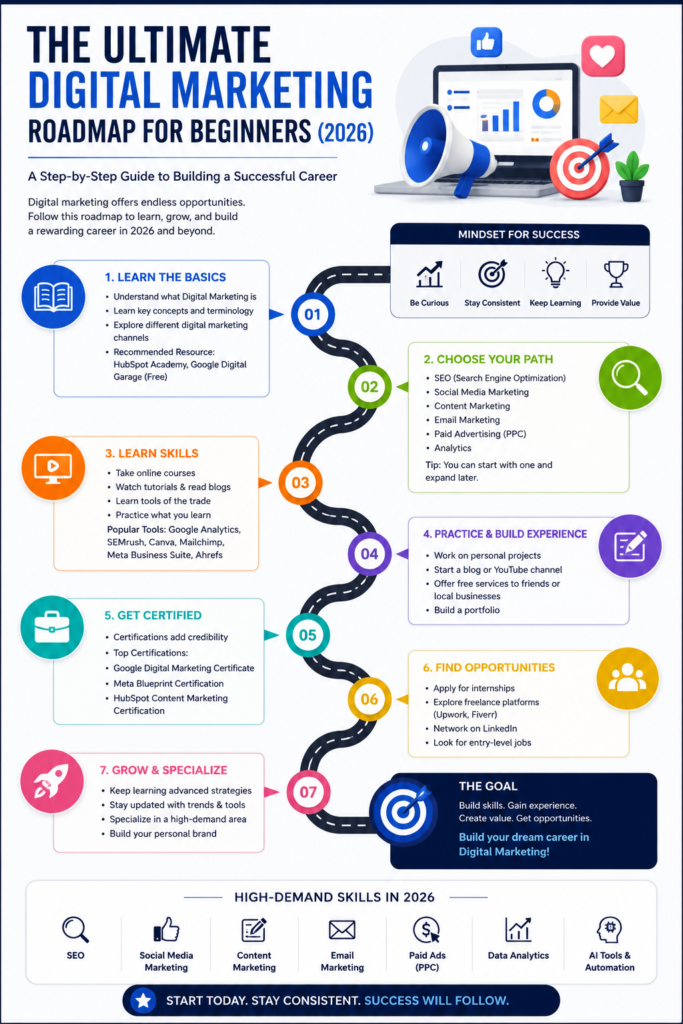
Digital marketing is no longer just another business skill—it has become one of the most valuable career and business opportunities of the digital age.
Whether you’re launching a startup, growing a small business, building a personal brand, or looking for a high-paying career, digital marketing opens doors that were almost impossible to access just a decade ago.
Today, billions of people spend hours online every day. They search for products, watch videos, compare brands, read reviews, and make purchasing decisions using digital platforms. Businesses follow this attention, investing heavily in digital marketing to reach the right customers.
The good news?
You don’t need a marketing degree to become a successful digital marketer.
What you need is a structured learning roadmap.
This guide will help beginners understand exactly what to learn, when to learn it, and how to gain practical experience that employers and clients actually value.
Why Digital Marketing Matters in 2026
The internet has changed how businesses grow.
Instead of depending only on television, newspapers, or billboards, companies now connect with customers through websites, search engines, social media, email, and online communities.
Digital marketing offers several advantages:
Reach customers anywhere in the world
Track every campaign using real data
Improve marketing based on performance
Build long-term customer relationships
Generate leads without massive advertising budgets
For beginners, it also creates countless freelance, remote work, consulting, and entrepreneurship opportunities.
Phase 1: Build Your Foundation
Before learning advanced marketing strategies, understand how the digital world works.
Focus on learning:
Marketing fundamentals
Customer psychology
Target audience research
Buyer journey
Sales funnel
Brand positioning
You should also understand the major digital marketing channels:
Search Engine Optimization (SEO)
Content Marketing
Social Media Marketing
Email Marketing
Google Ads
Affiliate Marketing
Influencer Marketing
Don’t try to master everything at once.
Your goal is understanding how all these channels work together.
Phase 2: Create Your Own Website
The best digital marketers learn by building.
Create your own WordPress website.
This becomes your learning laboratory.
Practice:
Publishing articles
Installing plugins
Optimizing website speed
Improving user experience
Learning basic website management
Even a simple blog teaches more practical skills than dozens of online courses.
Phase 3: Learn SEO
SEO remains one of the highest-value digital marketing skills.
Understand:
Keyword Research
Search Intent
On-page SEO
Technical SEO
Internal Linking
Backlink Building
Core Web Vitals
Instead of chasing quick ranking tricks, focus on creating useful content that genuinely solves people’s problems.
Long-term SEO always wins.
Phase 4: Master Content Marketing
Content is how businesses educate, attract, and convert customers.
Learn how to create:
Blog articles
Case studies
Tutorials
Comparison guides
Industry insights
Email newsletters
The goal isn’t simply publishing more.
It’s publishing content people trust enough to share and return to.
Phase 5: Understand Paid Advertising
Organic traffic takes time.
Paid advertising delivers faster results.
Start learning:
Google Ads
Meta Ads
LinkedIn Ads
Retargeting
Audience Segmentation
Campaign Optimization
Even if you don’t become a PPC specialist, understanding paid advertising makes you a stronger marketer.
Phase 6: Learn Analytics
Successful marketers rely on data—not assumptions.
Become comfortable with:
Google Analytics
Google Search Console
Google Tag Manager
Conversion Tracking
Ask questions like:
Where are visitors coming from?
Which pages perform best?
Why do users leave?
Which content generates conversions?
Data helps answer these questions.
Phase 7: Choose Your Specialization
After building a strong foundation, specialize.
Popular career paths include:
SEO Specialist
Content Strategist
PPC Expert
Social Media Manager
Email Marketing Specialist
Marketing Automation Consultant
Digital Marketing Manager
Deep expertise usually creates more opportunities than trying to become average at everything.
Build a Portfolio
Experience matters more than certificates.
Create real projects.
Examples include:
Ranking your own blog
Running Google Ads campaigns
Growing a LinkedIn audience
Improving website traffic
Building email subscribers
Document every result.
Employers hire proof—not promises.
Certifications Worth Considering
While certifications won’t replace practical experience, they strengthen credibility.
Useful certifications include:
Google Analytics
Google Ads
HubSpot Academy
Semrush Academy
Meta Blueprint
Treat certifications as supporting evidence—not the main qualification.
Common Beginner Mistakes
Avoid these mistakes:
Learning everything at once
Ignoring SEO
Publishing low-quality AI content
Copying competitors
Chasing vanity metrics
Quitting too early
Consistency beats intensity.
Small improvements every week produce remarkable long-term results.
The Role of AI
AI has become an essential marketing assistant.
Use AI to :
Brainstorm ideas
Research topics
Create outlines
Improve writing
Automate repetitive tasks
However, never let AI replace your thinking.
The strongest marketers combine AI efficiency with human creativity, experience, and judgment.
Final Thoughts
Digital marketing is constantly evolving.
New platforms appear.
Algorithms change.
Consumer behavior shifts.
But one principle remains constant:
Businesses reward marketers who solve real problems.
Don’t focus on becoming the person who publishes the most content.
Focus on becoming the marketer who creates the most value.
Build skills.
Practice consistently.
Measure everything.
Keep learning.
Your first website, first campaign, and first article may not be perfect—but they are the foundation of a successful digital marketing career.
The best time to begin is today.